Behind the Seams: The True Value of 'Made in the USA'
We want our kids to be safe, happy, and healthy, right? And in today’s day and age, that means reading food labels, checking toy safety ratings, researching car seat certifications, and the like. But what about clothing labels? Do you pay attention to where a garment is made?
Chances are, you care about where clothing is made, but when you find that adorable sleepsack, you go for it, throwing those fabric concerns to the wind.
But here’s the thing to know. The U.S. is one of the largest apparel markets, yet around 97% of the clothes sold here are made in other countries. And the reality is that where clothing is made tells a story. It affects the workers who sew it, the environment around those factories, the quality of the finished product, and how much a buyer actually knows about what they purchased.
So, the way we see it, with Independence Day right around the corner, there's no better time to think about what American-made clothing really means for families.
Quick Answer: Why Does "Made in the USA" Matter?
Clothing made in the U.S. can offer real advantages. These include closer quality oversight, stronger labor protections, shorter supply chains, and lower transportation emissions. For parents, especially, it often means more transparency into how a garment was made and by whom.
Not every domestic product is automatically better than one made elsewhere. But American manufacturing tends to give brands more direct control over materials, production standards, and working conditions. That matters when you're dressing a baby.
What Parents Might Not Know About the Journey of Clothing

You probably know where your car is made. You likely even know where your groceries are coming from. But did you know that before a T-shirt lands on a store shelf, it may have traveled to four or five countries? Cotton might be grown in India, shipped to another country to be spun into thread, sent somewhere else to be dyed, and then assembled in yet another location. China and India are among the largest cotton producers in the world. Polyester and other synthetic fabrics start as fossil-fuel-based materials and follow similarly long global routes.
These lengthy supply chains make it genuinely hard for a shopper to know where their clothes come from. A tag might say "Made in Vietnam," but omit the fact that the fabric originated elsewhere under conditions no one inspected.
The clothing industry has faced growing scrutiny over worker treatment and greenhouse gas emissions for years. Long supply chains multiply both risks. When more hands touch a garment across more countries, it becomes harder for a brand to track what actually happened along the way. Understanding the origin is the first step toward making a more informed choice.
How American Manufacturing Can Reduce Environmental Impact
Every mile a garment travels adds to its environmental footprint. And that’s something we, as consumers, want to pay attention to these days.
A shirt made overseas may pass through several factories, multiple shipping containers, international freight hubs, and domestic distribution centers before it ever reaches a customer. Domestic production omits many of those steps.

Fewer shipping stages mean less fuel burned. Did you know that cargo ships are responsible for 3% of all greenhouse gas (GHG) emissions each year? It’s true, and that equates to about 1 billion tons of CO₂ annually.
Less reliance on large cargo ships reduces one of the more significant sources of transportation emissions in global trade. A shorter supply chain also tends to generate less excess packaging and fewer opportunities for material waste along the way.
That said, no manufacturing process is free from environmental impact. Fabric production uses water and energy. Dyes and finishes can carry their own concerns. But when production happens closer to home, at least some of those burdens shrink. For parents who already think about the environmental footprint of the products they buy, clothing origin is worth adding to that list.
What Ethical Production Means for Families
So where are we going with all of this? Most parents want to know that what they buy was made responsibly. That desire is especially strong when the product touches a baby's skin all night long. When you buy clothing made in the U.S., you can take comfort in the fact that federal and state labor laws are in place. This means:
-
Minimum wages are in place
-
Working hours are limited
-
Safer working environments
Unfortunately, those protections do not exist in every country where clothing is produced.
But when we purchase domestically, we have better visibility into what is happening inside the supply chain. When a factory is a few states away instead of across an ocean, it’s a lot easier to oversee what’s going on. A brand can visit. They can ask questions. They can respond faster if something goes wrong. They can make decisions that result in safe clothing for our children to wear.
Don’t we all want transparency when we’re buying products for our kids? Of course we do. Parents deserve to know who made the sleeper their infant wears every night, and whether those workers were treated fairly. Supporting responsible manufacturing also signals to the broader industry. When families choose brands that make ethical production a top priorityt, they help push standards upward across the market.
Why Quality Control Often Starts Closer to Home
When a brand manufactures domestically, it can stay involved at every stage. Designers can communicate directly with production teams. Quality checks can happen in person rather than over email or through a third-party inspector in a distant country. Problems can be caught and fixed before a product ships.
This matters a lot for children's clothing. Baby pajamas get washed constantly. They go through hot dryers, repeated cycles, and the general chaos of toddler life. Clothing that holds up to that kind of daily use will need more attention during the manufacturing process. Fabrics need to be preshrunk correctly. Seams need to hold. Zippers and snaps need to work after a hundred washes.
Long-term value is worth thinking about here. A well-made garment that lasts through two or three children costs less over time than a cheaper one that pills, fades, and falls apart after a season. Quality control is about more than price. It is about whether the item will still look and function well a year from now.
The Gap Between What Consumers Want and What They Buy
We did some digging and found that 78% of consumers prefer American-made clothing when given the option. But that doesn’t seem to be what’s happening in reality. Only about 2.5% of apparel spending actually goes toward domestic brands. That gap is so much larger than what we’d like to see.
But the question is, why is that gap so large? Quite simply, it’s because American-made clothing can be harder to find. Many shoppers simply do not know which brands are manufactured domestically. Others assume the price difference is larger than it often is. And in a busy store or a fast online shopping session, the country of origin is easy to overlook.
This is why we encourage parents to ask the broader questions.
-
What did this garment cost to make?
-
Who paid that cost?
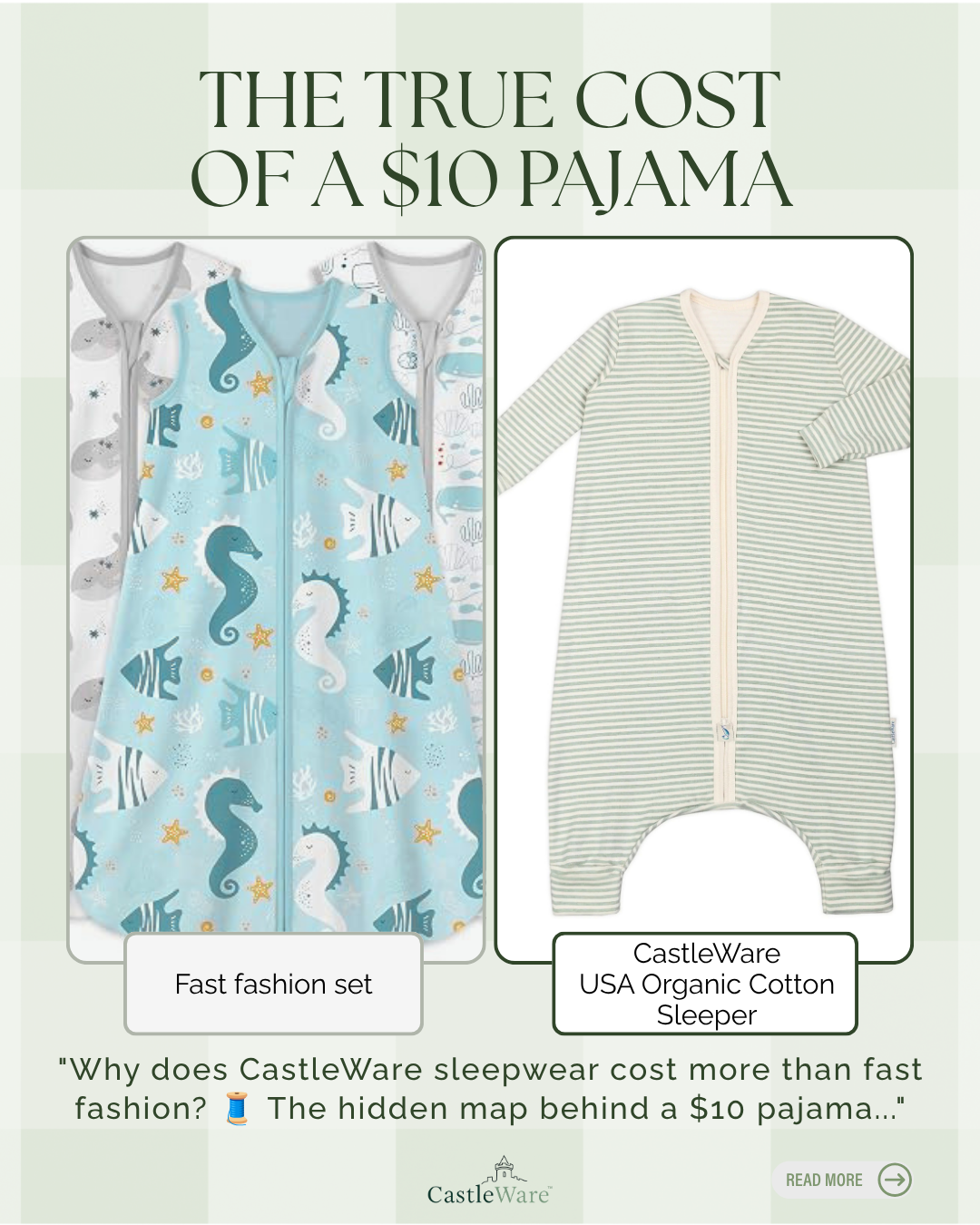
Workers, local communities, and the environment often bear the costs of what consumers save at checkout. The full price of a garment includes more than what appears on the receipt.
Castleware Encourages You to Look Beyond the Label
Where clothing is made connects to values that most families already hold. Cleaner production protects the environment. Fair labor practices protect workers. Close quality oversight protects your kids when they are wearing those garments. This Fourth of July, American craftsmanship is worth celebrating. Of course, this isn’t obligatory. Rather, we choose to celebrate that the choices families make every day add up to something real.
CastleWare makes all of its children's clothing in the USA, from fiber to finish, using GOTS-certified organic cotton. GOTS stands for Global Organic Textile Standard. It is one of the most respected certifications in the textile industry, covering everything from how the cotton is grown to how the finished garment is processed. If you are looking for baby and kids' clothing made with care, transparency, and quality you can count on, take a look at what CastleWare has to offer.
Frequently Asked Questions
Is Made in the USA clothing always made entirely in America?
Not necessarily. Labeling rules can be complex. Some products are cut and sewn in the United States but use fabric or materials sourced from other countries. The FTC requires that a product labeled "Made in USA" be "all or virtually all" made domestically, but standards for terms like "Assembled in USA" are looser.
When in doubt, check a brand's website for details about where their fabrics come from, not just where garments are assembled. Brands that provide visibility into the supply chain, from raw material to finished product, make this easy to verify.
Does Made in the USA clothing cost more?
Yes, clothing that is “Made in the USA” does typically come with a higher price tag. And a big part of that pricing is in labor costs. In the U.S., workers must be paid a minimum wage of $7.25 per federal law (though most states require much higher wages). But outside of the U.S., some factory workers made the equivalent of just $3 per day.
But there is more to the price of American-made clothing than just labor costs. A well-made garment that holds up through years of washing and wear can be a better long-term investment than a less expensive item that wears out quickly.
Well-made pieces are more likely to be passed down to siblings or friends or resold at used clothing stores. That can increase a piece's value exponentially. So, when you look at the price of American-made clothing for kids, consider the following:
-
Quality
-
Lifespan
-
Manufacturing practices
How can I tell where children's clothing is made?
To know where a piece of clothing is made, start by checking the garment’s label. The Federal Trade Commission (FTC) and U.S. Customs and Border Protection (CBP) require that pieces sold in the U.S. bear a country-of-origin label.
For more details, you can also check the brand's product descriptions and website. Many responsible brands publish information about where their fabrics are sourced and where garments are produced.
Be wary of vague language. You want specifics. A brand that says "made in our North Carolina facility from certified organic cotton grown in the USA" is giving you real information. A brand that says only "responsibly sourced" is not. When transparency is a priority for a company, they tend to make that information easy to find.

Written by CastleWare LLC